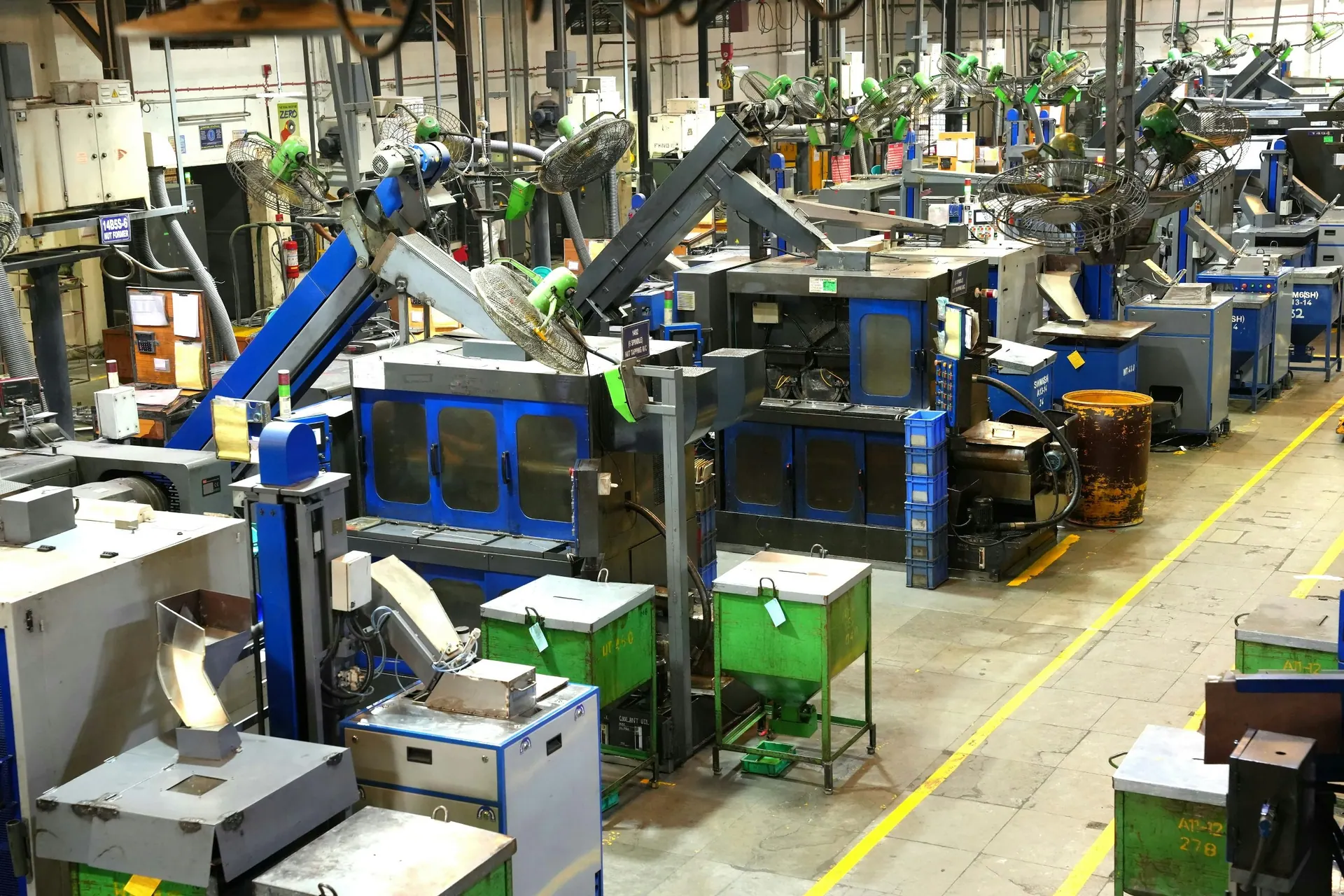
Walking the site before installing
A day on site with the facility team saves weeks of rework after the devices arrive.
- 1B02Mounting & power✓
Wall, pole or cabinet; PoE budget or 24 V DC nearby.
- 2C01Network & cabling✓
Cable routes, switch ports, Wi-Fi and LTE coverage.
- 3F02Environment✓
IP rating for dust and monsoon rain, heat near furnaces, cold rooms.
- 4E02Existing devices✓
Turnstiles, locks and CCTV models checked, as in every IQ Face and IQ Guardian survey.
- 5D03People & shifts✓
Who works where and when; install windows that do not stop work.
- 6D01Permits✓
Electrical, height and hot-work permits; who may open which cabinet.
Every device that should speak
One row per device type: how it talks, what it says, how often, and who owns it.
Reading the rhythm: F a live stream, Q every second, Fl every minute, Fl(2) every five minutes, LFl every fifteen, Oc on each event. Each row also names its owner on site.
Factory lines: beside PLCs and machines
We read machines without touching their control logic, and add small devices where no data exists yet.
States, counters and alarms over OPC UA, S7 or Modbus TCP, read-only.
A small MCU board with our firmware: current, vibration and counts out on RS-485.
A reject signal from inspection to the line, as in QC Automation.
Thermal cameras on electrical panels with staged alarms, as in IQ Fire.
Devices at gates and in buildings
Face terminals, cameras and door controllers, connected to the people records behind them.
On existing turnstiles through relay, Wiegand or OSDP; entries go to NFFICE HR.
Existing cameras over ONVIF and RTSP, events from IQ Guardian.
Zones and time rules per group; doors released on fire alarm.
Pre-registered visitors enter by face; escorts and zones set per visit.
Who is inside each zone now, for safety and muster lists.
Logistics yards and cold chain
Trailers move, doors open and temperatures drift; devices here run on batteries and cellular links.
- 1Trailer trackers
LTE-M and GPS, a position every five minutes while moving (example).
- 2Temperature loggers
BLE loggers in cold rooms and boxes, with alarms on limits.
- 3Dock doors
Open time per door and per shift, linked to the truck at the dock.
- 4Reefer power
Plug status and set point of refrigerated containers.
- 5Forklifts
Hours, impacts and driver ID from a small telematics unit.
- 06:103 cold rooms · 48 loggers · 12 dock doors
- 06:41Alarm: room 2 at 8.4 °C for 11 min, door 7 open
- 07:00Daily cold-chain report sent to Osaka in Japanese
Connecting power and energy meters
Meters by line, floor or tenant turn one monthly bill into numbers people can act on.
kWh, kW, power factor and harmonics over Modbus RTU.
Sub-metering of a line or machine without cutting cables.
Generation and status through SunSpec Modbus models.
Pulse outputs counted by a battery node, or NB-IoT meters.
15-minute readings, aligned in UTC across sites (example).
0122 meters · 4 compressor lines · rooftop solar
02Compressor 3 draws 18 % more at night than its twin
03Defrost schedule changed → 6 % less energy in a month
Wired field buses
Most machines and meters already speak a field bus; reading it well is mostly about the details.
Two wires, 120 Ω at both ends, up to 32 unit loads, register maps per vendor.
The same registers over Ethernet; polling rates set so the PLC is never slowed.
CANopen or J1939 on vehicles and machines; bus load kept under 60 % (example).
OPC UA, S7 or EtherNet/IP, read-only unless control is agreed.
Wiegand on older gates, OSDP where the line must be encrypted.
4–20 mA loops and dry contacts through an I/O module.
Choosing a radio: range, power, data
No radio wins everywhere; the site, the battery and the payload choose between them.
Tags, loggers and setup from a phone
Mains-powered devices with more data
Small readings from wide sites; EU868, AS923, KR920 and US915 plans
Meters and trackers without local gateways
Sensors and controls in offices and homes
Gateways and cameras that need a backhaul
Rhythms are illustrative (example): short, rare pulses last years on a battery; a steady signal needs mains power.
Seven jobs of a gateway
A gateway is a small Linux computer on site that turns many local signals into one secure stream.
Modbus, BLE or OPC UA in, MQTT out.
One naming scheme, SI units and UTC time stamps.
Send changes and minute averages, not every raw sample.
Keep data while the uplink is down, then send it in order.
Raise an alarm on site even when the cloud is unreachable.
Field devices stay on a local network; only outbound TLS leaves.
Health reports, configuration and signed updates from the centre.
Messages over MQTT and OPC UA
The protocol follows the data: telemetry over MQTT, machine models over OPC UA, video over ONVIF and RTSP.
Publish / subscribe telemetry; QoS 1 for readings, retained last state, last-will on disconnect.
Birth and death certificates so the centre knows which devices are alive.
Machines described as objects with types and units; PubSub where volumes are high.
Camera discovery, streams and events across brands (Profiles S and T).
Rare, large or file-based exchanges such as snapshots and logs.
Through the hub into business systems
Device data is worth something only when it lands in attendance, work orders, reports and decisions.
Things, Device Shadow for desired and reported state, rules to route messages.
Device twins, the Device Provisioning Service and direct methods.
EMQX or Mosquitto when data must stay in the building or the country.
IQ Face entries become attendance records in NFFICE HR.
IQ Guardian alerts reach the site manager and an action report in NFFICE.
IQ Fire warnings open a repair approved in NFFICE; AI Ontology links causes.
Installation and commissioning list
Each device is labelled, registered, tested point by point and handed over with drawings.
QR label with the device ID that matches its certificate.
By your electrical contractor to the survey drawings.
Scanned with a commissioning app; placed on the site map.
Every reading and alarm triggered once and seen in the system.
Final positions, IPs and cable routes recorded.
Short sessions per shift in Korean, Vietnamese, English or Japanese.
GW-HP-L3-017 · Hai Phong plant · line 3
six faces checked before handover
same ID as its certificate
Embedded & IoT questions
Will installation stop production?
We plan around shifts and planned stops. PLC reading is read-only, and most sensors and terminals go in during short windows.
Can we keep our turnstiles and cameras?
In most cases, yes. Gate, lock and camera models are checked in the site survey, and we connect to what you already have.
Can you connect old machines that have no network port?
Often through a serial port, a PLC already on the line, or retrofit sensors for current, vibration and counts, wired to a gateway.
LoRaWAN or NB-IoT for a site in Vietnam?
It depends on who runs the network. LoRaWAN needs your own gateways but no SIM fees; NB-IoT and LTE-M use an operator and suit spread-out meters.
Cloud IoT hub or a broker on our own servers?
Cloud hubs are quick to start and scale across countries; an on-premise broker fits when data must stay on site. The data model stays the same either way.
Can site device data appear in NFFICE?
Yes, as in our own products: gate entries become attendance in NFFICE HR, and camera or heat events become action reports and work orders.
Where is device data stored, and who can see it?
Where you choose: a cloud region, your own servers or both. Access follows roles per site and entity, and personal data such as faces is handled under local law.
Who does the physical installation?
Your facility team or electrical contractor does the mounting and wiring to our drawings; our engineers register, test and commission the devices and data.
Can the same devices be used in Korea, Japan, Europe and Vietnam?
Often the same design, with radio variants and approvals per country, such as KC, Japanese radio certification, CE and local type approval in Vietnam.
What happens when a device breaks?
Fleet monitoring usually spots it first. A spare from site stock is swapped in, takes over the old settings, and the faulty unit goes back for analysis.
