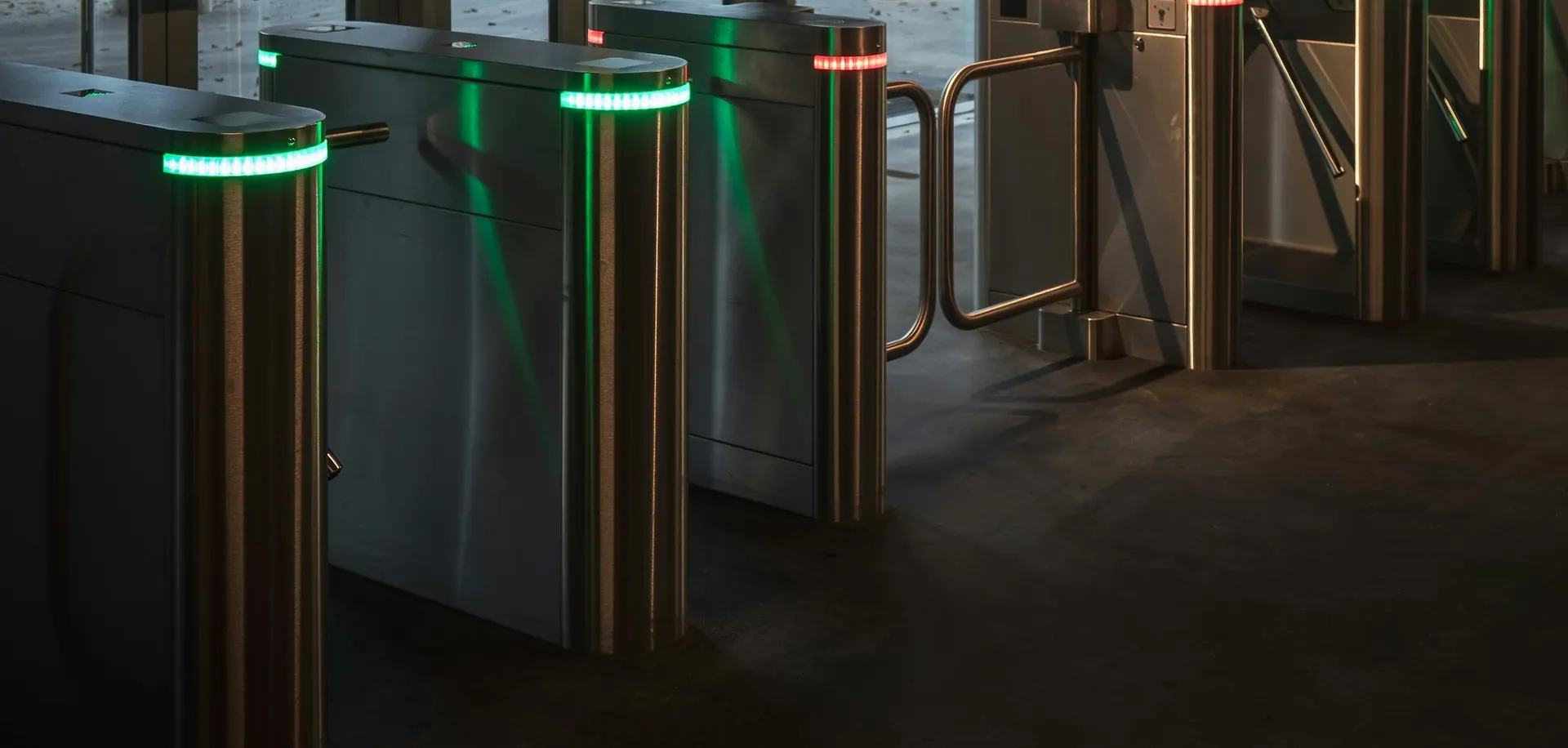
Access at the gate
At the gate the terminal first checks that a live face is in front of it — not a photo or a screen — then compares it with the people allowed through that gate at that hour, and opens the turnstile. One face, one passage.
Each card turns over to show the answer.
Cards, PINs and paper sign-ins can be used for someone else — buddy punching.
Entry needs a live face that matches an enrolled person — a photo or a phone screen does not open the gate.
HR matches gate logs, paper sheets and overtime forms line by line.
Each entry and exit lands in NFFICE HR as attendance, with shift, night hours and overtime already worked out.
No live headcount when it matters — least of all in an emergency.
Headcount is live by zone, company and gate, and the muster list is ready the moment the alarm sounds.
Subcontractor and day-worker records sit in each company’s own sheet.
Crews are enrolled by company, with induction and permit dates — entry stops when one lapses.
Each feature with a real scene and the screen behind it.
At the gate the terminal first checks that a live face is in front of it — not a photo or a screen — then compares it with the people allowed through that gate at that hour, and opens the turnstile. One face, one passage.
Every entry and exit becomes a record in NFFICE HR. First in and last out are matched to each person’s shift; night hours (22:00–06:00) and overtime are worked out by your company’s rules and checked against the overtime cap.
Subcontractor crews are enrolled by company, with safety-induction and permit dates on each record, so entry stops when one lapses. Visitors are pre-registered by their host, get only the areas and hours of the visit, and their face data is removed when it ends.
Doors inside the site record who enters each zone, so headcount is live by zone, company and gate. Unknown faces and entries to restricted zones raise an alert with a snapshot, and when the alarm sounds the muster list shows who is still inside.
Unknown face · Gate 03 · snapshot to security
Zone D · no permit · entry denied
Night shift · 64 people on site
Drill · muster list 64 of 64 found
Each person is enrolled once, after a privacy notice and recorded consent. Matching uses a face template; where it is stored, who can see snapshots and how long data is kept are set with your legal team, and data is deleted when someone leaves.
Detection, liveness, template match and gate signal run on the terminal; figures are typical values tested per site.
Finds the face, checks pose and sharpness, and aligns the eyes for a clean crop.
Pose within ±30° typicalPresentation-attack detection rejects photos, screens and masks.
Tested to ISO/IEC 30107-3A neural network turns the face into a numeric template; matching uses no photo.
512-D vector, about 2 KBCompared with everyone allowed at that gate and time; the threshold sets FAR.
< 0.5 s for 10,000 facesRelay, Wiegand or OSDP opens the lane; the entry goes to NFFICE HR.
Relay, Wiegand 26/34, OSDPCard plus face (1:1) for high-security doors
Larger sites sync templates from a server by gate group
Scored with ISO/IEC 30107-3 metrics (APCER, BPCER)
Masks lower accuracy, as NIST FRTE tests have measured
OSDP (IEC 60839-11-5) adds encryption over RS-485
Enrollment photo kept only if agreed; retention per policy
Impostor attempts accepted at the set threshold, from site test logs.
Enrolled staff refused on the first try, helmets included.
From face in frame to relay output, timed at the lane.
People per minute per lane at shift change, counted on video.
Typical targets, agreed per site in the acceptance test.
In force 1 Jan 2026; face data is sensitive: notice, consent and impact assessment.
Biometric data used to identify a person is sensitive and needs separate consent.
Face feature data is an individual identification code; the purpose of use must be stated.
Biometrics are special-category data; the AI Act bans emotion recognition at work.
Written release and public retention policy; delete within 3 years of last contact.
Attendance, shifts, payroll
Leave and overtime approvals
Restricted zones on camera
Alarm opens the muster list
Existing turnstiles and doors
Face data is treated as sensitive personal data under Vietnam’s Personal Data Protection Law, in force since 1 January 2026. It generally needs a clear notice, recorded consent and an impact assessment — we help prepare these with your legal adviser, who confirms what applies to you.
You choose: on your own servers (on-premise) or in a dedicated cloud environment. Storage location, encryption, access and retention are agreed in the security review before installation.
Conditions differ by site. We test helmets, masks, glasses and lighting at your gates during the site survey and confirm the results before rollout.
No. IQ Face works on its own, and existing turnstiles and locks can be connected in most cases — checked in the survey. With NFFICE HR, entries become attendance automatically.
No. The terminal first checks that it sees a live face, not a photo or a screen, and only then matches it against the people allowed at that gate at that time. Liveness is tested at your own gates during the survey.
The terminal keeps working from its own list of enrolled people and stores each entry, then syncs with NFFICE HR when the link is back. How long it can run offline depends on the terminal model.
Contractor workers are enrolled under their company with safety-training and permit expiry dates, and entry stops when one lapses. Visitors are registered in advance by their host, enter only their areas during their time window, and their face data is deleted when the visit ends.
Yes. Doors inside the site record who entered each zone, so headcount by zone, company and gate is live, and when the alarm sounds the evacuation list shows who has not come out yet.
We recommend keeping another way to record their time, such as a card reader or a guard-logged entry, so no one is left out. Biometric data needs clear consent under the Personal Data Protection Law 91/2025/QH15 (VN), as it does under PIPA (KR), GDPR (EU) and BIPA (US), so the exact policy is set with your legal adviser.
The usual set-up keeps face templates on site and sends only attendance results to HQ. Moving personal data out of Vietnam brings its own duties under 91/2025/QH15 (VN), and at the receiving end PIPA (KR), APPI (JP), GDPR (EU) or US state laws apply as well.