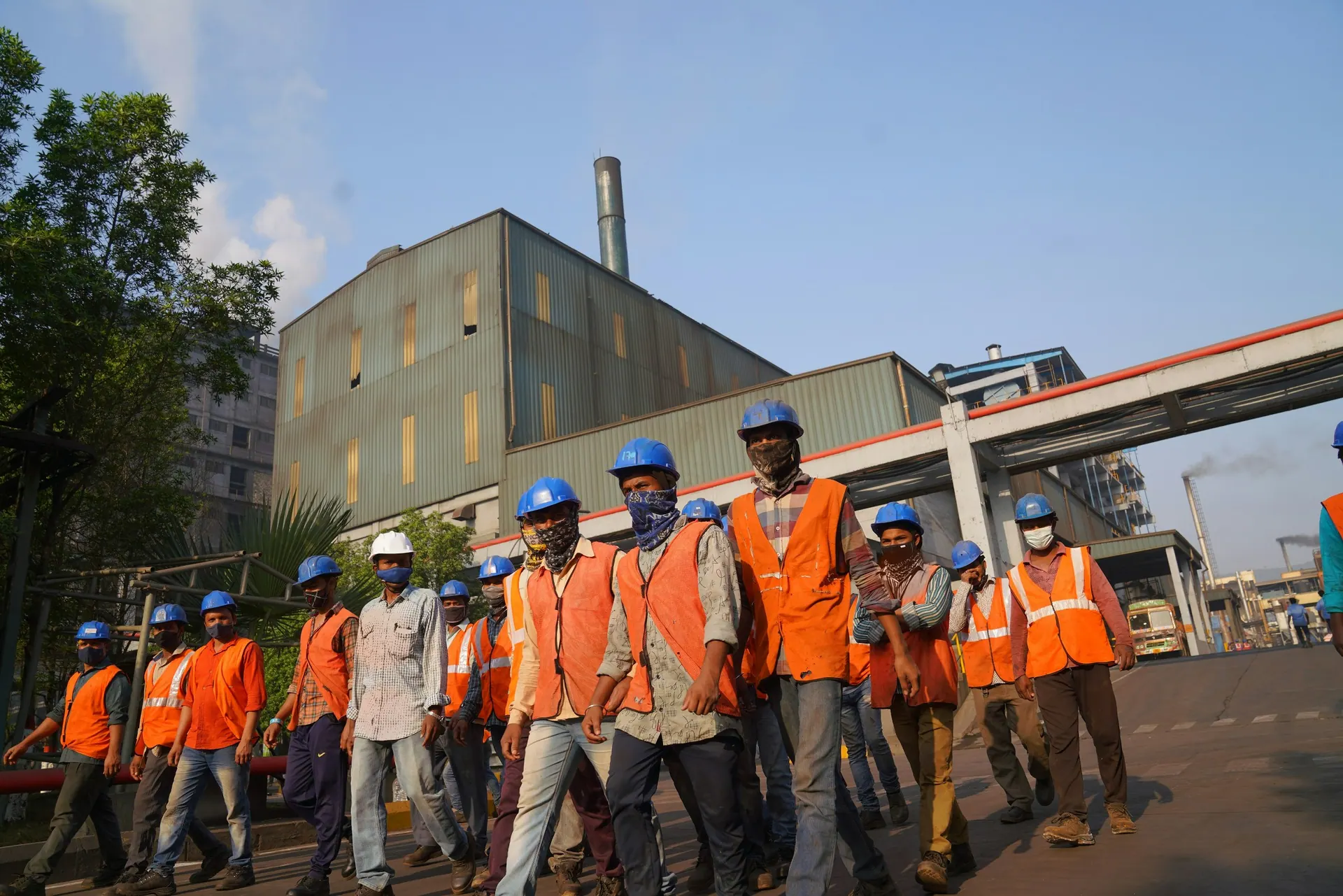
One plant, seven sets of rules
Each zone has its own entry, PPE and camera rules.
PPE checked zone by zone
Cameras check the gear each zone asks for, not one rule for the whole plant.
- IQ Guardian reads existing IP cameras (RTSP / ONVIF), checked camera by camera in the survey.
- Rules are set per zone and per shift; the alert goes to the lead of that zone.
People out of forklift lanes
Where people and trucks cross, the camera watches the gap between them.
Where a machine’s hours go
OEE splits planned time into availability, performance and quality losses.
Availability × Performance × Quality
- Availability92%−8.0%p
- Performance95%−4.6%p
- Quality98%−1.7%p
- Planned time100.0
- Run time92.0
- Net run time87.4
- Good-part time85.7
92 % × 95 % × 98 % = 85.7 % (example)
- Breakdowns
- Unplanned stops from equipment failure — the loss condition monitoring targets first.
- Setup & adjustment
- Die and mould changes, warm-up and first-article checks.
- Small stops
- Jams and blocked sensors that each last minutes but add up over a shift.
- Reduced speed
- Running below the rated cycle time, often to hide a worn tool or a hot motor.
- Process defects
- Scrap and rework during stable running.
- Start-up rejects
- Parts lost until the line settles after a stop or changeover.
Heat limits for panels and motors
A hot spot is judged against a similar part under the same load, not one fixed number.
- 1–3 °Cabove a similar part
Possible deficiency — keep on the trend, recheck
- 4–15 °Cabove a similar part
Probable deficiency — repair at the next planned stop
- > 15 °Cabove a similar part
Major — reduce load and repair now
- +4 °C/minrate of rise
Warning even below the limit — a fault still warming up (example)
- Scan at 40 % load or more; at low load a loose joint hardly warms.
- Shiny copper reflects; read it on emissivity labels or through IR windows.
- IQ Fire: fixed radiometric cameras, limits per zone, staged alarms with a snapshot.
Which signal shows which fault
Each failure mode shows first in a different signal, so sensors are chosen by mode.
- Vibration severity is read in zones A–D (machines above 15 kW).
- P–F interval: ultrasound and vibration move weeks before heat; heat moves before smoke and noise.
- IQ Fire covers temperature. Your existing vibration, current and oil data join the same asset in AI Ontology.
- Anomaly models on your sensor data are built through AI model development.
From an alarm to a closed repair
Every alarm moves across the same board until the camera confirms the fix.
Motor M-07 bearing 9 °C above its sister motor (example)
Greased 41 days ago; its last two failures were bearings (example)
WO-2207 with snapshot, trend and a 6205 bearing from spare stock (example)
Repair set for the 14:00 planned stop; isolation needed
Closed with a photo; bearing back within 2 °C of its sister (example)
Mean time between failures: running hours ÷ failures, per asset.
Mean time to repair: from stop to restart, per failure.
Planned work hours ÷ all maintenance hours.
PLC tags into one machine record
Gateways read the controllers and send events, not floods of raw values.
- 06:00:02[opcua]Press03.State = RUNNING
- 06:41:17[modbus]Press03.MainMotor.Current = 38.2 A
- 06:41:17[mqtt]plant/bn1/press03/m07/temp = 71.4 °Cwarn
- 06:41:18[onto]event → asset Press #3 · motor M-07 · line 2
- 06:41:19[nffice]WO-2207 drafted · waiting for approval
- 06:41:20_
- L4ERP — orders, cost, spare parts
- L3MES and historian — work orders, lots, trends
- L2PLC, SCADA, HMI — where the gateway reads
- L1Sensors and drives
- Read-only by default; anything written back to a PLC is agreed in writing and tested at a planned stop.
- Protocols per controller: OPC UA where the PLC offers it, otherwise Modbus TCP/RTU, RS-485 or MQTT.
- Gateways buffer data while the network is down and send it when it returns.
- Gateway software is built by Development Biz (embedded & IoT).
Stop, lock, verify, then repair
Before hands go into a machine, every energy source is isolated and proven dead.
- 1Prepare
List every energy source: electric, air, hydraulic, gravity, springs.
- 2Notify
Tell the operators affected; the shift lead agrees the stop.
- 3Shut down
Normal stop from the HMI, not the emergency stop.
- 4Isolate
Breaker off, air valve closed, hydraulic pressure bled.
- 5Lock & tag
One personal lock per worker, a tag with name and date.
- 6Release stored energy
Block the raised ram, discharge capacitors.
- 7Verify
Try to start; measure — zero energy confirmed.
- 8Restore
Tools out, guards back; each lock removed by its owner only.
- US
OSHA 29 CFR 1910.147 — control of hazardous energy
- KR
산업안전보건기준에 관한 규칙 제92조 — stop, lock and sign during maintenance
- JP
労働安全衛生規則 第107条 — stop, lock the starter, post a sign
- VN
Law on OSH 84/2015/QH13 — employer’s safe work procedures
The isolation checklist rides on the work order as a site form in NFFICE Groupware; the approval asks for it signed.
Night hours and overtime caps
Gate times become shift hours, split by pay rate and checked against the caps.
From a face at the gate to payroll
One entry record flows into attendance, approvals and the pay-period close.
Live face check at the turnstile; snapshot on every in and out; unknown faces denied.
First-in and last-out become a shift day; normal, night and overtime hours split.
Overtime and leave approved by the line lead in KO, VI or EN.
Closed hours by pay rate, by Excel or API.
- Contractors grouped by company, each with a permit expiry date
- Live headcount per zone and a muster list in an evacuation
- Proxy punching with shared cards
- Paper sheets retyped at month-end
- Gate log and payroll that never match
Faces and footage, handled right
What is settled before the first face is enrolled and the first camera analysed.
- Purpose written down: attendance and safety, not scoring people
- Biometric data is sensitive personal data; consent says so (Law 91/2025/QH15, Decree 356/2025/ND-CP)(VN)
- Worker-monitoring equipment discussed in the labour-management council; biometrics as sensitive data under PIPA(KR)
- Face feature data is an individual identification code under APPI; purpose published(JP)
- GDPR Art. 9 for biometrics and Art. 88 for employment; the AI Act bans emotion recognition at work since 2 Feb 2025(EU)
- Faces blurred in safety snapshots — PPE rules look at gear, not identity
- Retention set per site; face templates removed when employment ends
- Every view and export of footage logged; HQ access from abroad follows cross-border transfer rules
Safety, equipment and working-time law
What each country asks of a plant, and the equipment record that helps, lane by lane.
Manufacturing site questions
Who gets a PPE or forklift alert on the night shift?
The lead of that zone on that shift, with a snapshot; the action taken is reported and approved in NFFICE.
Do the panel doors have to be open for thermal checks?
No. IR windows fitted at a planned stop let cameras see the busbars with the door closed, which also keeps people outside the arc-flash boundary.
We already have vibration sensors. Can you use their data?
Yes. Existing sensors, PLC tags and historian data are read through a gateway and linked to the same asset in AI Ontology; nothing is replaced.
Who decides that a repair goes ahead?
A person. AI Ontology drafts the work order with its evidence; the maintenance lead approves it in NFFICE before anything is scheduled.
Can the system write to our PLCs?
Only for signals agreed in writing, such as a stop request, tested at a planned stop. Everything else is read-only.
Will the gate slow down at shift change?
The number of lanes is sized from peak arrivals per minute, measured in the survey, so hundreds of people can pass in a few minutes.
Can contractors and day workers use face entry?
Yes. They are grouped by company, limited to their zones and hours, and their access ends on the permit expiry date.
Who sets our overtime rules?
You do, from your internal labour rules. NFFICE HR applies them per entity and warns before the legal caps are reached.
What if someone does not consent to face enrolment?
Another way of recording attendance is kept for them; data-protection rules expect consent to be freely given.
Does video leave the plant?
Analysis runs on an edge server on site; only events and snapshots reach NFFICE. Cloud storage is used only if agreed.
