What one test vehicle records
Five sensor types, their rates and what each frame carries (example rig).
One hour of city driving at these rates is 36,000 LiDAR sweeps (10 Hz) and 648,000 camera frames (6 cameras × 30 fps).
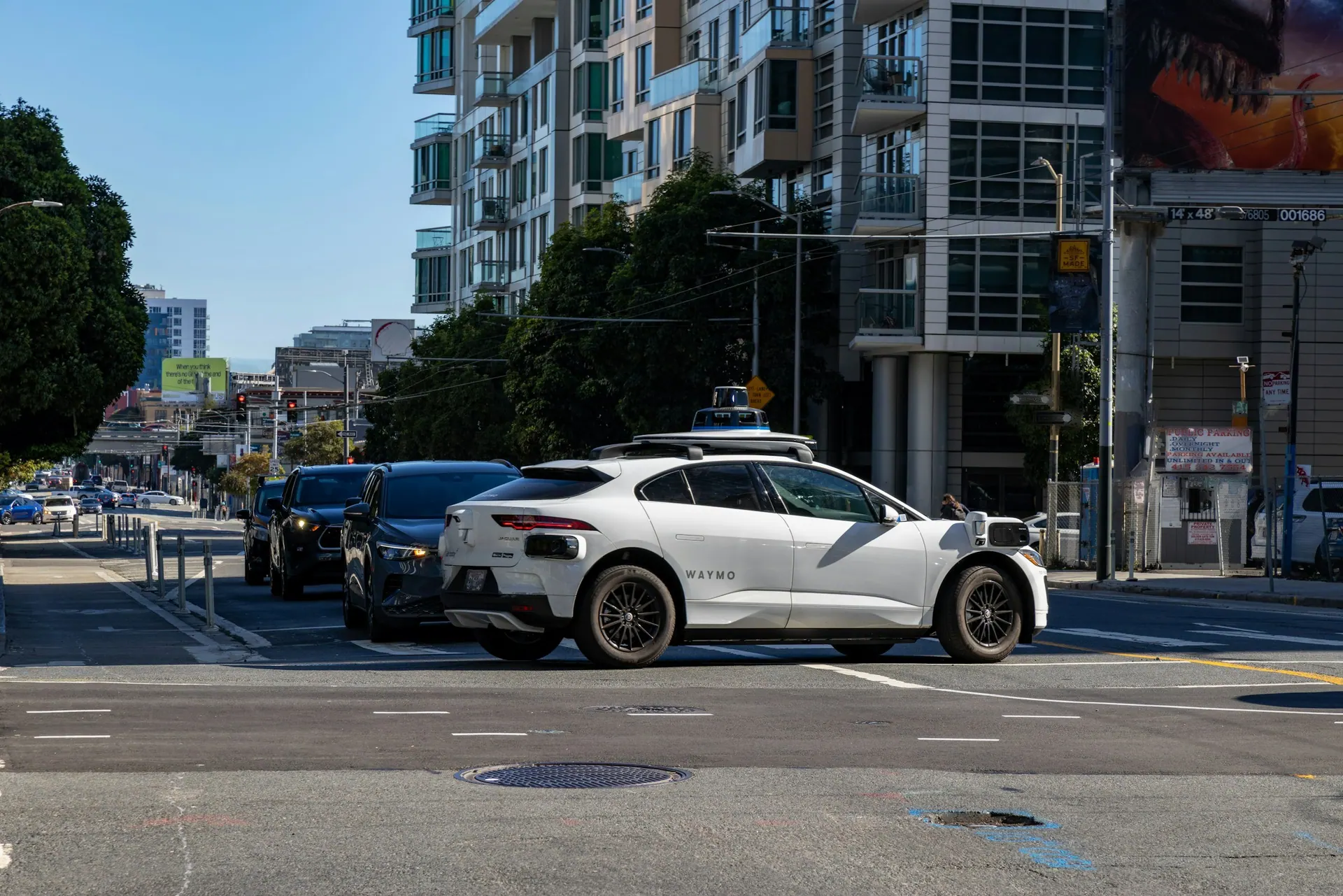
PhotoSensor test car at the kerb, side view; dots mark the real sensors
Pixels with intrinsics K and lens distortion; 360° around the car
Position and attitude: the ego pose that ties frames to the map
x y z, intensity and time per point, out to about 200 m
Speed, steering angle, brake and indicator signals
Range, azimuth, Doppler speed; sees through rain and fog
Small offsets, large errors
Each frame’s reprojection error is plotted against a 3 px line before labeling.
- ✓200 frames sampled · 198 under 3 px · median 1.2 px
- !2 frames at 4.6 px right after a pothole
- ↩Sequence returned for extrinsics before labeling starts
PhotoThe test car’s roof unit and corner camera; points projected from LiDAR onto the real kerb, lane paint and hydrant
- Extrinsic rotation 0.1°≈ 8.7 cm off at 50 m
LiDAR points projected onto poles and kerbs in the camera image
- Time offset 10 ms≈ 28 cm at 100 km/h
Lane paint and poles drift the same way frame after frame
- One LiDAR sweep = 100 msStraight walls bend at speed
Points motion-compensated with the ego pose
- Wrong distortion coefficientsLane lines curve at the image edge
Intrinsics re-checked on a straight-line target
Five labels on one drive
Boxes, tracks, point classes, fusion and lanes, with format and pass line (example).
PhotoThrough the test car’s windscreen: a multi-lane road and a signalised junction
Centre x y z, size l w h and heading (yaw) per object; people label keyframes at 2 Hz in a 10 Hz sequence.
- Format
- KITTI · nuScenes · OpenLABEL
- Pass line
- 3D IoU ≥ 0.70 · heading ≤ 5° (example)
One ID per object for the whole sequence, kept through occlusion; speed and parked / moving state per frame.
- Format
- nuScenes instance · OpenLABEL frame_intervals
- Pass line
- ID switches ≤ 1 per 1,000 frames (example)
A class for every point: road, sidewalk, building, vegetation, vehicle, person.
- Format
- SemanticKITTI · nuScenes-lidarseg
- Pass line
- mIoU ≥ 0.90 (example)
The same object in camera and LiDAR under one ID; the 3D box projects into every camera.
- Format
- nuScenes calibrated_sensor · KITTI calib
- Pass line
- Reprojection ≤ 3 px (example)
Centre lines, boundaries, stop lines and crosswalks as 3D polylines, linked lane to lane.
- Format
- OpenDRIVE · Lanelet2
- Pass line
- Lateral error ≤ 10 cm (example)
Work runs in AI Studio, INFINIQ’s own labeling environment, or in your platform.
What one pick asks of the data
Now the robot arm: on a real pick cell, each piece of hardware and the stream it leaves.
- 01Overhead camera
Whole bin, for choosing what to pick
- 02Force / torque sensor
Contact, slip and insertion
- 03Wrist camera
Sees the part as the gripper closes
- 04Gripper
Did it close on the part or on air
- 05Joints
The action the policy has to learn
- 06Bin and tray
Shiny, tangled parts; where success is judged
All streams share one clock (PTP or a hardware trigger); skew stays within 5 ms (example).
One episode, frame by frame
An operator drives the arm with a leader arm; five frames show each step.
ep_0412
Scene set from the task card; episode ID ep_0412 opened
Leader joints mirrored at 50 Hz; three cameras recording
Gripper width 46 → 31 mm; current rises on contact
Force sensor shows the part’s weight; no slip
Part inside the tray zone, gripper open, still for 1 s
Hands filmed with consent
Head-camera video of real assembly work, masked before anyone labels it.
- 01Consent
Signed per person and site before the first take; withdrawal means deletion
- 02Script
Tasks filmed in order: pick, fit, fasten, check
- 03Mask
Coworkers’ faces, name badges, screens and papers blurred
- 04Narrate
Timestamped lines such as “C fits the bracket”
- 05Segment
Verb–noun steps with start and end frames; hand and active-object boxes
Sample sites: assembly benches in Hai Phong, Nagoya and Stuttgart (fictional plants).
Where and how a part is held
Grasp rows for one bin image; the highlighted rows failed review (example).
From recorded to trainable
How one week of demonstrations narrows to what a policy learns from (example).
- Recorded
All episodes from two operators
- In sync
Skew ≤ 5 ms, dropped frames ≤ 0.1 %
- Success labeled
Part in tray, gripper open, still for 1 s
- Failures kept apart
Reason from a taxonomy
- Instructions written
One instruction + 3–5 paraphrases in VI · KO · EN · JA
Rare scenes, city by city
Scenes a fleet seldom records, and the label rule each one needs (examples).
PhotoMotorbike with a long load in mixed trafficChildren crossing a residential streetCyclist on a narrow roadTram tracks and lanes under snowRoad works with drums and a temporary signHeavy rain: a car and its reflection on the wet road
Motorbike swarms at an unsignalled junction, riders carrying long loads
→Rider and motorbike as one box; the load gets its own attributeChildren stepping out between parked cars in a 30 km/h school zone
→Truncation and occlusion flags on small pedestriansNarrow residential lanes with utility poles and bicycles on the pavement
→Cyclists split by where they ride: road or pavementTram tracks in the lane and snow covering the paint
→Hidden lane spans marked as inferred, not drawn as seenRoad works with orange drums and temporary lane lines
→Temporary lanes get a work-zone attributeTropical downpour: wet road reflections and drops on the lens
→Phantom LiDAR points below the road go to the noise classSynthetic bins, judged on real
Rendered scenes add volume; a real hold-out set decides the mix (example).
- Scenes in Isaac Sim or MuJoCo
- Light 200–1,800 lux, 36 part textures, pose jitter
- Auto-labels audited on samples: mask IoU ≥ 0.95
Grasp success on 600 real hold-out picks, never mixed into training
- Real only0.81
- Real 80 : synthetic 200.84
- Real 60 : synthetic 40chosen0.87
- Real 40 : synthetic 600.83
Scenarios tested inside the ODD
Each ODD cell is assigned to simulation, a closed track or public roads.
PhotoA closed course at night: test car and cone gates
- Functional
“A car cuts in from the right lane.”
- Logical
Speed 30–60 km/h, gap 5–25 m, cut-in time 1–3 s
- Concrete
One value set per run, written in ASAM OpenSCENARIO on an OpenDRIVE map
- Verdict
Time-to-collision ≥ 1.5 s and no lane departure (example)
QA Biz writes the catalogue and runs it in your simulator or on your track; every case comes back with video and a verdict.
Faces and plates go first
Masked before storage or labeling; the log keeps every frame and reviewer.
- (KR) PIPA Art. 25-2: mobile video devices recording in public must show it by light, sound or sign (since 15 Sep 2023)
- (VN) PDP Law 91/2025/QH15 and Decree 356/2025/NĐ-CP, in force 1 Jan 2026
- (JP) APPI · (EU) GDPR · (US) CCPA/CPRA
PhotoEye-level view across a crosswalk in front of the test car
Safety rules for driving stacks
Vehicle safety standards and national rules, in the order they took effect.
Functional safety: faults in electrical and electronic systems, ASIL A–D
Hazards without a fault: perception limits and foreseeable misuse
Scenario-based safety evaluation framework for automated driving
(JP) Driverless “specific automated operation” by prefectural permit from 1 Apr 2023
(EU) Cyber security and software-update management required for all new vehicles from July 2024
Safety of AI elements in road vehicles, including trained models
(VN) Road Traffic Order and Safety, from 1 Jan 2025: smart vehicles defined (Art. 34) and need operating authorization (Art. 35)
(KR) Performance certification from 20 Mar 2025: makers certify and sell AVs that safety standards do not yet cover
(US) Standing General Order, third amendment from 16 Jun 2025: crash reports for ADS and Level 2 ADAS
(UN) WP.29 adopted a global ADS regulation in June 2026: safety case, safety management system, in-service monitoring
(EU) High-risk duties for AI in products under EU product law apply from 2 Aug 2028
Zones, limits and test cases
The cell plan with the standard behind each zone and the test run there.
- 1Fenced robot zoneISO 10218-2:2025
Door opened mid-motion → protective stop; stop time logged
- 2Collaborative workspaceISO 10218-2:2025 (absorbs ISO/TS 15066 limits)
Contact force measured at hand height against the body-region limit
- 3Speed & separation zoneISO 10218-2:2025 · ISO 13855
Person approaches at 1.6 m/s; arm slows, then stops at the set distance
- 4Operator stationISO 10218-1:2025
Enabling device released → motion stops
- 5Conveyor handoverTask card end state
100 picks: success rate and cycle time per pick (example)
- EUMachinery Regulation 2023/1230, in force 20 Jan 2027
- KROccupational Safety rule Art. 223: fence may be omitted where the cell meets KS B ISO 10218
- JPOrdinance Art. 150-4 and the 2013 notice: collaborative work allowed after risk assessment
- USANSI/A3 R15.06, the US adoption of ISO 10218
- VNAI Law 134/2025/QH15 in force 1 Mar 2026
QA Biz runs and records the tests; conformity is declared by the integrator.
From 20 sequences to a test cycle
Five columns a first project moves through, and what lands in each.
PhotoTest vehicle on a proving-ground track
- Logs as ROS bag, MCAP or PCD
- Calibration files and timestamps
- Draft class list
- Projection overlays
- Time-offset table
- Bad sequences sent back
- 20 sequences, about 1,000 frames
- Gold-set score and error report
- Guideline v1.1
- Keyframes by people, frames between interpolated
- AQL sampling inspection per batch
- Delivery in your format
- Test catalogue from the ODD
- Runs in your simulator or on your track
- Verdict and video per case
Data, model work and tests can sit under one contract and one project lead.
Mobility & robotics FAQ
Do you build vehicles or a self-driving stack?
No. We collect and label the data your stack learns from, help with perception and edge models in AI development, and test the behaviour through QA Biz.
Can you collect driving data as well?
Yes. Vehicle rigs drive routes planned against a quota sheet — time of day, weather, road type — in Korea, Japan, Vietnam and other countries, and each clip keeps GPS and CAN logs.
Can you run the teleoperation sessions too?
Yes. Trained, consented operators record in our studio or at your site, and we also label the logs you already have.
Which formats do you take and deliver?
PCD, PLY, BIN, ROS bag or MCAP in; KITTI, nuScenes, Waymo Open, Argoverse 2, OpenLABEL, OpenDRIVE, Lanelet2 or your own schema out.
Do people label every LiDAR frame?
People label keyframes, for example 2 Hz in a 10 Hz sequence; frames between are interpolated with ego motion removed, and only jumps are fixed by hand.
How are language instructions for VLA models written?
One clear instruction per episode or step plus 3–5 paraphrases by native speakers in VI, KO, EN and JA; “it” and “there” are rejected in review.
Can your testers write OpenSCENARIO files?
Yes. Scenarios are written from your ODD as functional, logical and concrete cases in ASAM OpenSCENARIO on OpenDRIVE maps, and run in the simulator you use.
Can a collaborative cell run without a fence?
Only where the risk assessment under ISO 10218-2:2025 and local rules allow it. We measure contact forces, speeds and stop distances; the integrator declares conformity.
Can driving video leave the country it was recorded in?
Faces and plates are masked before transfer. Vietnam asks for a cross-border transfer impact file, the EU for a GDPR transfer basis; teams can also work through VDI on your own servers.
What is the smallest robot-data pilot?
50 episodes or 5 hours of video: guideline agreed, captured and labeled, fully reviewed, with gold scores and an error report.